
By: Kitty Halpern, Strategic Communications and Knowledge Management Consultant and Dorte Verner, Lead Agriculture Economist in Food and Agriculture Global Practice (GFADR)
What was once considered a niche idea is rapidly entering the policy and practice mainstream. At the Regional One Health Conference for Eastern and Southern Africa held in Lusaka, Zambia on December 11-12, 2025, insect farming emerged as one of the most discussed and dynamic topics, reflecting growing interest in solutions that can simultaneously address food security, waste management, public health, climate change, and job creation.
With support from the Korea Green Growth Trust Fund (KGGTF), the World Bank is advancing the Insect Farming for Food and Feed for a Circular Green Growth Economy initiative, helping countries unlock the full potential of insects as food, feed, fertilizer, and engines of local economic growth.
Why Insects and Why Now
Insect farming offers a rare multi-win solution at a time of rising fertilizer prices, mounting organic waste, growing food imports, and urgent demand for youth employment.
Unlike wild-harvested insects, which are often available only seasonally and risk overharvesting, farmed insects can be produced year-round under controlled conditions. This improves food safety by regulating feed inputs and avoiding exposure to harmful pesticides. Compared to conventional livestock, insects generate up to 20 times fewer greenhouse gas emissions per kilogram of edible protein, while converting organic waste into high-value products.
Globally, more than 2,100 insect species are consumed, yet fewer than 20 are farmed at scale. At the same time, global food systems rely on roughly 30 livestock species. Expanding insect farming presents a major opportunity to diversify protein sources and strengthen food system resilience.
In Africa alone, more than 850 insect farms are already operating. In Malawi, insect farming is expanding rapidly, with over 288 farms currently active. In many countries, 81 percent of edible insects are consumed directly by humans, while others are increasingly used as animal feed.
Food, Feed, Fertilizer, and Jobs
Not all consumers may choose insect-based burgers, but insects play a critical role across food systems.
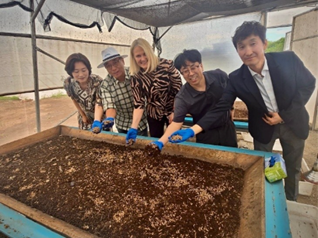
Black soldier fly larvae can substitute for imported fishmeal and soy protein in poultry, aquaculture, and livestock feed. Farmers working with the program can raise black soldier flies in just a few weeks, compared to months required for traditional livestock, significantly reducing production time and costs.
Insects feed on organic waste such as food scraps, agricultural residues, and market waste. This process produces frass, a nutrient-rich organic fertilizer that improves soil health and boosts yields. Nothing is wasted. The result is a fully circular system that creates jobs along the entire value chain while reducing emissions and public health risks associated with unmanaged waste.
Korea’s Experience as a Living Laboratory
Client countries are expressing strong interest in learning from Korea’s experience in building a full insect industry ecosystem. Korea has raised insects for thousands of years, but recent growth reflects deliberate government leadership, science-based regulation, and sustained investment.
The Rural Development Administration (RDA) has played a central role by funding research, supporting farmers, transferring technology, and establishing a rigorous approval system for insect-based foods. New species are evaluated for safety and toxicity before entering the market, supported by clinical studies.
Research in Korea has shown that insect protein improves gut health in both humans and animals, reducing veterinary costs and contributing to preventive health benefits. Promising findings are also driving research into applications related to cancer care and Alzheimer’s disease.
Since 2017, insect farm income in Korea has increased by 153 percent, demonstrating how coordinated policy, science, and market development can rapidly scale a new sector.
Through the Korea Program on International Agriculture (KOPIA), Korea has extended its expertise globally, with centers in countries such as Zimbabwe contributing to local economies and partnerships expanding across Africa.
From Knowledge to Scale
KGGTF-supported knowledge exchanges and policy dialogues are now helping African countries adapt Korea’s model to local contexts. This includes regulatory frameworks, farmer training, pilot programs, and regional collaboration under an approach that links human health, animal health, and environmental sustainability.
Following the regional conference, partners agreed to deepen collaboration and co-host a joint regional conference in Zimbabwe, marking a shift from awareness to coordinated scale-up across Southern Africa.
As the global lead for alternative protein and TTL at the World Bank noted:
“My dream is for Africa to become a leader in insect farming.”
— Dorte Verner, Lead Agriculture Economist, World Bank
By transforming waste into food, feed, fertilizer, and jobs, insect farming is demonstrating how circular economy solutions can deliver climate action, economic opportunity, and healthier food systems. With Korea’s experience as a guide and strong demand from client countries, the sector is poised to scale rapidly across the region.
Watch the full discussion (starting at 6:09) https://www.youtube.com/watch?v=72bDy8NLtjI